
Hello Neighbor- Pantry Building: Dry Soup Mix in a Jar

There is something comforting about opening your pantry and knowing that dinner is already waiting for you.
Life gets busy. Some days you don’t have the time or energy to cook from scratch, but that doesn’t mean your family has to settle for takeout or highly processed convenience foods. Filling your pantry with homemade shelf-stable meals is one way to make future you thankful for the work you put in today.
One of my goals when building a pantry is creating meals that are convenient without sacrificing quality.
Today’s project isn’t about following a perfected recipe—it’s about walking through the process of creating one. I want to show you how I experiment in my own kitchen and how one simple idea can turn into a pantry staple your family can enjoy for months.
Our goal? A homemade dry soup mix in a jar made with ingredients we’ve preserved ourselves.
Start With the End in Mind
Before I ever start cooking, I ask myself a simple question:
“If I couldn’t run to the store, how would I make this myself?”
For this soup mix, that meant breaking the project into smaller pieces.
We needed:
A homemade chicken bouillon
Dehydrated vegetables
A starch
A protein
Seasonings
Instead of buying those ingredients individually, I wanted to create as much of them as possible from scratch.
Experimenting With Homemade Bouillon
One of the biggest challenges was creating a homemade bouillon powder.
My first attempt focused on dehydrating chicken stock by itself. While it worked in theory, reducing enough liquid to create a usable powder simply wasn’t practical.
So I changed my approach.
After roasting a chicken, everything went into the stock pot:
Bones
Skin
Fat
Pan drippings
Every bit of flavor
The broth simmered for hours before the bones were removed.
Nothing went to waste.
The softened bones were pureed into a nutritious treat for our grand dog, while the broth continued reducing.
Once chilled, I removed the hardened fat and kept the rich collagen-filled broth underneath.
From there, I added:
Chicken meat
Carrots
Celery
Onion
Garlic
Ginger
Lemon zest
Oregano
Parsley
Thyme
Hot pepper
Everything cooked down until thick before being blended into a smooth puree.
Learning Through Trial and Error
Not every experiment goes exactly as planned—and that’s okay.
Originally, I tried drying the mixture in the oven.
The pan I chose was too large, creating a layer that was too thick to dry efficiently. The oven also wasn’t removing moisture fast enough.
Instead of starting over, I adjusted.
I transferred everything onto dehydrator trays, where it dried successfully over the next ten hours.
That became my homemade bouillon powder.
Sometimes the biggest lesson isn’t the finished product—it’s learning how to adapt when something doesn’t work the first time.

Dehydrating the Vegetables
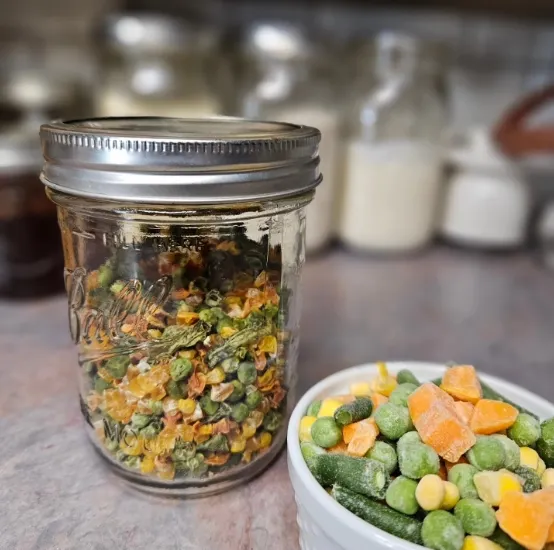
For this project, I chose frozen mixed vegetables.
They’re already cleaned, cut, and ready to use, making them a wonderful option for preserving food that’s been sitting in the freezer a little too long.
I began drying them at a slightly higher temperature to compensate for the extra moisture from being frozen before lowering the temperature to finish the drying process.
If you don’t own a dehydrator, your oven can also work. Most ovens don’t go quite as low as a dehydrator, so you’ll simply need to monitor them more closely to avoid over-drying.
Once fully dehydrated and properly conditioned, these vegetables can be stored for an extended period in airtight containers.
It’s also a wonderful way to rotate older freezer foods into long-term pantry storage instead of letting them go to waste.
Application: Building the Soup Mix
Once all the individual ingredients were finished, it was time to assemble the soup jars.
For each jar I used:
½ cup rice
½ cup black beans
½ cup dehydrated mixed vegetables
3 tablespoons homemade chicken bouillon powder
1 teaspoon dehydrated onion
I chose black beans because they cook in roughly the same amount of time as the rice, making them a great pairing for a one-pot meal.
When it’s time to cook, simply empty the jar into a pot, add about two cups of water, and simmer until the rice and beans are tender.
You can certainly enjoy it as-is, or add cooked chicken or other meat if you’d like to make it even heartier.
I also package these soup mixes in Mylar bags so they’re easy for my husband to grab when he needs a simple meal away from home.
More Than Just a Soup Mix
This project wasn’t really about soup.
It was about learning to think differently about the food we already have.
Instead of relying on packaged convenience meals, we can create our own using ingredients we’ve grown, preserved, or intentionally stocked in our pantry.
Every experiment teaches us something.
Some recipes become family favorites.
Others simply teach us a better way to approach the next project.
Either way, we’re building skills that make our homes a little more prepared and a little more self-sufficient.
Neighbor’s Takeaway
🌿 Pantry building doesn’t happen all at once—it grows one project at a time.
🌿 Don’t be afraid to experiment. Some of the best recipes come from trying something new.
🌿 Homemade convenience foods can be just as practical as store-bought options while using ingredients you already have on hand.
🌿 Putting things away on the shelf today helps you in future days.
— Nivek
Leaf & Bean Farm
Hello Neighbor-Pantry Building: Dry Soup Mix in a Jar


Comments